Exploring Higher Education Opportunities in Germany and UK
Exploring Higher Education Opportunities in Germany and UK
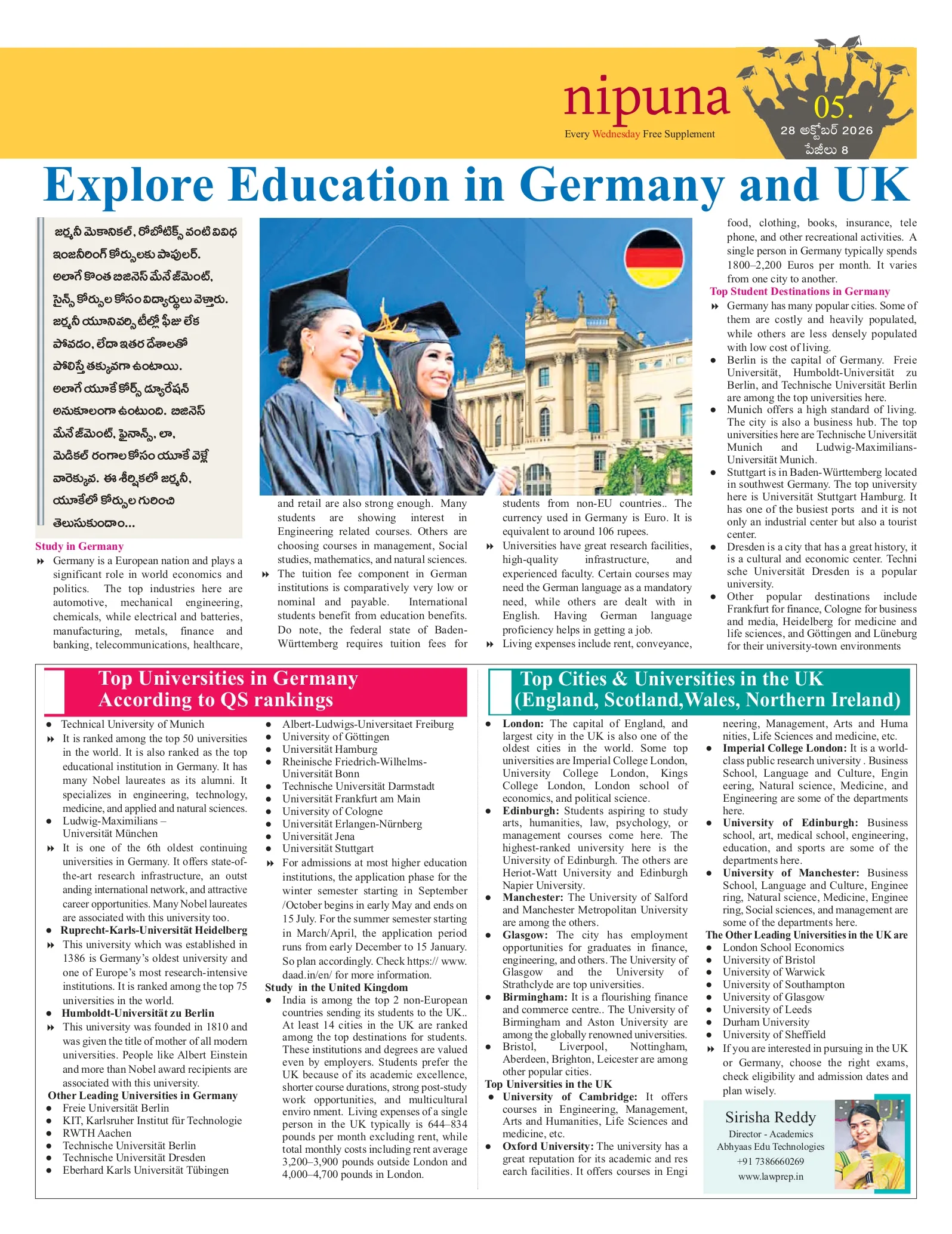
Germany and the UK are two of the most popular destinations for Indian students who want a European education. Germany is known for engineering, low tuition and strong research. The UK is known for short courses, globally recognised degrees and career-focused programs. This guide explains what each country offers, what it costs and how to choose between them.
Germany vs UK at a Glance
| Point | Germany | UK |
|---|---|---|
| Tuition | Very low or nominal at most public universities, with some state-level exceptions | Higher, and varies by university and course |
| Master’s duration | Usually about 2 years | Usually 1 year |
| Teaching language | English and German programs | English |
| Strong fields | Engineering, automotive, technology, sciences | Business, finance, law, medicine, humanities |
| Language need | German needed for some courses and for jobs | English test only |
| Main intakes | Winter (main) and summer | September (main) and January |
Why Study in Germany?
Germany has one of the strongest economies in Europe, and its leading industries include automotive, mechanical engineering, chemicals, electrical and battery manufacturing, finance, telecommunications, healthcare and retail. This is why engineering and technical courses attract so many international students, along with management, social sciences, mathematics and natural sciences.
Tuition and costs. Most public universities charge little or no tuition, which makes Germany far cheaper than many other study destinations. The state of Baden-Württemberg is an exception, where non-EU students pay a tuition fee. Students still pay a small semester contribution.
Living expenses. A single student typically spends around 1,800 to 2,200 euros a month on rent, food, transport, insurance, phone and other needs. The amount depends on the city.
Language. Many programs are taught in English, but some courses require German. Even where it is not required, knowing German makes daily life easier and helps you find a job.
Top Cities in Germany
- Berlin: The capital, home to Freie Universität Berlin, Humboldt-Universität and Technische Universität Berlin.
- Munich: A high standard of living and a business hub, with Technical University of Munich and Ludwig-Maximilians-Universität.
- Stuttgart: An industrial centre in the southwest, home to Universität Stuttgart.
- Dresden: A city with a rich cultural and economic history, known for Technische Universität Dresden.
- Others: Frankfurt for finance, Cologne for business and media, Heidelberg for medicine and life sciences, and Göttingen and Lüneburg for a quieter university-town setting. Hamburg is one of the busiest port cities and a popular choice too.
Leading Universities in Germany
Technical University of Munich, Ludwig-Maximilians-Universität München, Heidelberg University, Humboldt-Universität zu Berlin, Freie Universität Berlin, KIT Karlsruhe, RWTH Aachen, Technische Universität Berlin, Technische Universität Dresden, University of Tübingen, Freiburg, Göttingen, Hamburg, Bonn, Darmstadt, Frankfurt, Cologne, Erlangen-Nürnberg, Jena and Stuttgart.
Rankings change every year, so check the latest QS list and the course page before you shortlist.
Why Study in the UK?
India is one of the largest sources of international students for the UK, and degrees from British universities are respected by employers. Students choose the UK for its academic quality, shorter course durations, post-study work options and multicultural environment. A one-year master’s saves both tuition years and living costs.
Living expenses. A single student’s monthly spending is typically around 644 to 834 pounds before rent. Including rent, total monthly costs average about 3,200 to 3,900 pounds outside London and 4,000 to 4,700 pounds in London.
Top Cities and Universities in the UK
- London: Imperial College London, University College London, King’s College London and London School of Economics.
- Edinburgh: University of Edinburgh, Heriot-Watt University and Edinburgh Napier University.
- Manchester: University of Manchester, University of Salford and Manchester Metropolitan University.
- Glasgow: University of Glasgow and University of Strathclyde, with good job openings in finance and engineering.
- Birmingham: University of Birmingham and Aston University, in a growing finance and business city.
- Cambridge and Oxford: The two most prestigious universities, with a wide range of courses.
- Other options: Bristol, Warwick, Southampton, Leeds, Durham, Sheffield, Liverpool, Nottingham, Aberdeen, Brighton and Leicester.
Who Can Apply? Eligibility and Documents
Indian students usually need a completed bachelor’s degree for a master’s program, or a school-leaving qualification for an undergraduate one. Minimum marks differ by university and course. Keep these ready:
- Academic transcripts and degree certificates
- A valid passport
- English or German language score
- Statement of purpose and recommendation letters
- Updated CV (for most master’s courses)
- Proof of funds
Language Tests You May Need
UK universities and English-taught programs in Germany generally ask for a recognised English test such as IELTS, TOEFL or PTE. German-taught courses need a German language certificate. Many programs set a minimum score for every skill, so check each course page. To compare the English tests, read our PTE vs TOEFL guide.
Intakes and Application Timeline
Start preparing 8 to 12 months before your intake.
- Germany, winter semester (October): Applications usually run from early May to 15 July.
- Germany, summer semester (March or April): Applications usually run from early December to 15 January.
- UK: Most universities admit in September, with a smaller January intake. Popular courses fill early.
Check the DAAD website and each university’s page, since dates can vary.
Student Visa Basics
Both countries need a student visa after you receive an admission offer.
- Receive your offer or admission letter.
- Arrange proof of funds. Germany uses a blocked account, and the UK checks your savings.
- Arrange health insurance (the UK adds a healthcare charge to the visa fee).
- Apply online and book your biometrics appointment.
- Plan ahead, since processing times vary by season.
Scholarships Worth Exploring
- Germany: DAAD scholarships, plus university and foundation awards.
- UK: Chevening, Commonwealth and GREAT scholarships, plus university-specific awards.
Deadlines are often a year before the course starts, so check them as soon as you shortlist your countries.
Germany or UK: How to Choose
- Choose Germany if you want low tuition, a technical or engineering course, or you are open to learning German.
- Choose the UK if you want a one-year master’s, a business, finance or law course, or you prefer to study fully in English.
- Look at the total cost, not only tuition. The UK’s shorter course can reduce your living costs, while Germany’s low fees can reduce your tuition.
- Plan your exams early. Choose the right language test and check eligibility and admission dates before you apply.
Setting your sights on Germany or the UK?
Choosing the right exams, meeting the eligibility criteria and keeping track of admission dates all start with early preparation. Explore our programs and get ready for your study abroad journey.
Frequently Asked Questions
Is education in Germany really free?
Most public universities charge little or no tuition, but you still pay a semester contribution, and some states charge international students a fee.
Is the UK or Germany cheaper?
Germany is usually cheaper for tuition, while the UK’s one-year master’s can lower total living costs. Compare the full cost of your course.
Do I need German to study in Germany?
Not for English-taught programs, but German helps with daily life and jobs.
Can I work while studying?
Yes, in both countries, within the limits set by your visa.
When should I apply?
About 8 to 12 months before your intake.
